“It’s Just Stress.”
Why those three words are dismissing the biggest health problem almost nobody is treating


You describe the exhaustion, the weight that won’t move, the 3 AM wake-ups, the brain fog. Your labs come back “normal.” And your doctor says the sentence millions of people hear every year.
“It’s just stress.”
Then you get sent home with nothing.
And more recently, women are hearing a different version of the same dismissal. It’s perimenopause. It’s menopause. Here’s your HRT. Hormone therapy has its place, and for some women it’s the right tool. But after working with so many women, I believe fasting insulin and cortisol are the two key labs we need to understand and optimize before we chase sex hormones. Too often, it was cortisol the whole time.
Here’s what I want you to understand. Stress is not a feeling you push through. It is a full-body hormonal event, and when it never turns off, it changes your blood sugar, your blood pressure, your sleep, your weight, and your ability to heal from anything else.
The medical name for this is HPA axis dysfunction. HPA stands for hypothalamus, pituitary, adrenal. It’s the communication line between your brain and the glands that make cortisol, your main stress hormone. I believe dysregulation of this system is one of the biggest unnamed epidemics we have.
How you were built
Your nervous system has two settings. The parasympathetic side is rest, digest, and repair. This is where healing happens. The sympathetic side is fight or flight, your survival system, and it is brilliant.
Picture your ancestor face to face with a tiger. In one second, cortisol and adrenaline surge. Blood sugar rises so your muscles have fuel. Blood pressure and heart rate climb so you can run. Digestion, fertility, and repair get put on hold, because none of that matters if you don’t survive the next five minutes.
Then the tiger leaves. Cortisol falls. Your body returns to rest and repair. That’s the design. Short bursts of stress, long stretches of safety.
Your body cannot tell the difference between a tiger and an inbox. So it responds to all of it the same way, and the alarm never shuts off. We are living in fight or flight as a lifestyle.
What causes HPA axis dysfunction
Feeling like you have to do it all, every day, with no real recovery
Constant bad news and social media scrolling, morning to night
Not enough time in nature or natural sunlight
Screens and artificial light after dark
Ultra processed food and blood sugar swings
Not moving your body, or overtraining without recovery
Poor sleep, night shifts, irregular schedules
Chronic infections, gut issues, and inflammation
Unprocessed grief, trauma, and emotional stress
The two faces of HPA axis dysfunction
High cortisol is usually where it starts. Stay in survival mode long enough and your smart body starts turning the system down to protect you. Researchers have proposed that after a prolonged period of HPA axis overactivity, the system flips into a low-output state, and low cortisol patterns show up in roughly 20 to 25 percent of people with stress-related conditions like chronic fatigue, fibromyalgia, and burnout (Fries, Psychoneuroendocrinology, 2005). That’s the tired-but-wired stage sliding into just plain tired.
Symptoms you might have
Trouble falling asleep, or waking between 2 and 4 AM
Exhausted in the morning, can’t get out of bed without caffeine
Wired at night when you should be winding down
Weight gain around your middle that won’t budge no matter what you do
Sugar and salt cravings
Afternoon energy crashes
Anxiety, racing heart, feeling on edge over small things
Brain fog and poor focus
Getting sick often, or slow to recover
Low libido and irregular cycles
Feeling burnt out, flat, and unmotivated
How to test for it
The least expensive place to start is a morning cortisol blood draw, done before 9 AM. Cortisol should be at its peak in the early morning. This one number is a snapshot, but it’s cheap, easy to get, and a reasonable first look.
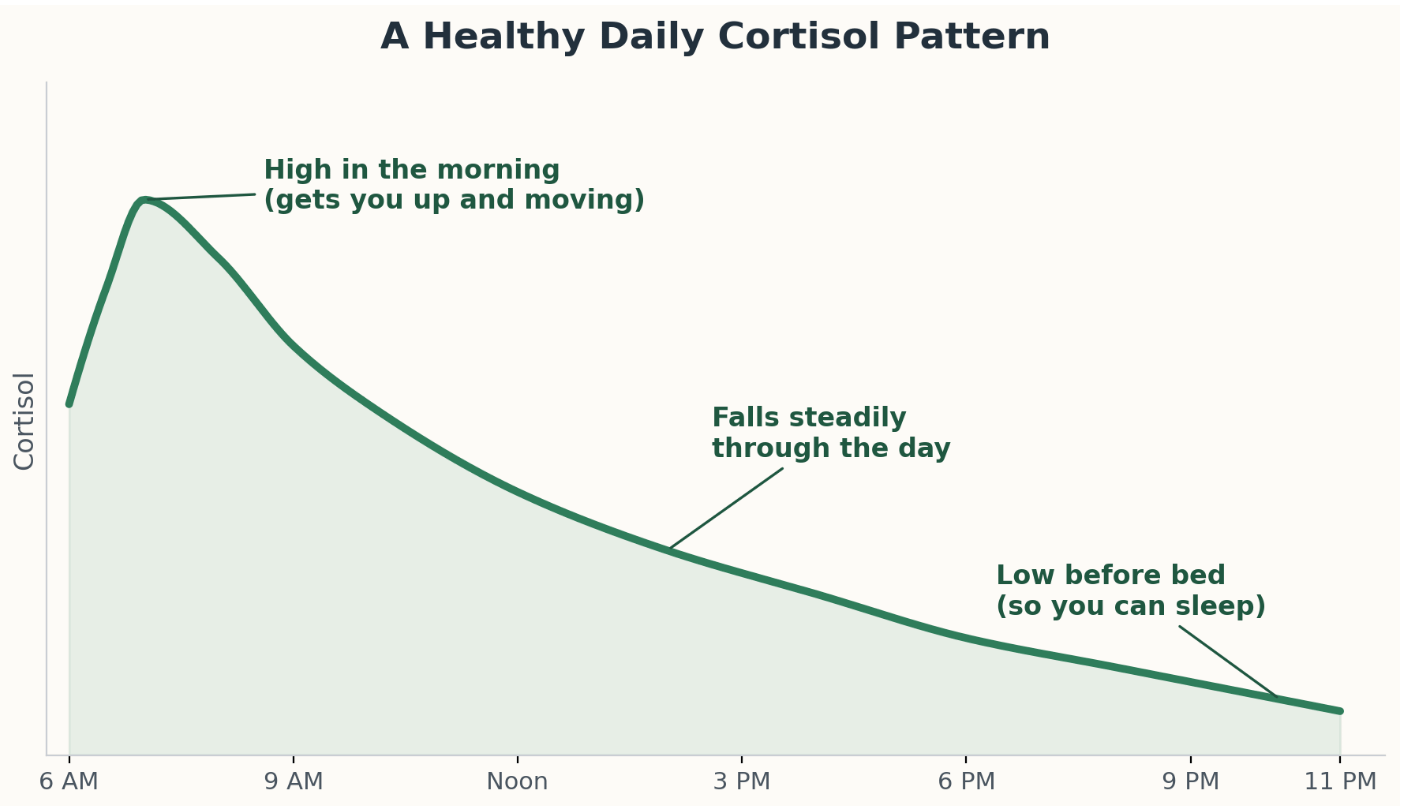
This is what a healthy cortisol rhythm looks like. High in the morning to get you up and out of bed, then falling steadily through the day so you can sleep at night.
In my practice I use the DUTCH test, because a single morning number can’t show me the pattern. The DUTCH test measures cortisol at multiple points across the day, and the pattern tells the story. I see people whose cortisol is spiking at night when it should be lowering before bed. That’s the person lying awake at 11 PM, wired. I see people whose morning cortisol is too low. That’s the person who can’t get out of bed and needs two coffees to feel human. Same complaint of “stress,” completely different pattern, completely different support.
Ask your provider for a morning cortisol. If you want the full picture, work with a practitioner trained in functional medicine who can run and interpret a full cortisol rhythm.
Why your healing plan isn’t working
Cortisol raises blood sugar. So you can eat clean and still struggle with glucose and insulin. Cortisol is associated with fat storage around the middle. So you can count every calorie and the scale won’t move. Fight or flight shuts down digestion. So you can take every gut supplement on the market and still bloat.
If your nervous system is stuck in survival mode, your body will not prioritize healing, because it thinks it’s still running from the tiger. I have watched patients do everything right, the diet, the exercise, the protocols, and stay stuck, until we supported the nervous system first. Then everything else started working.
Your doctor wasn’t wrong when they said it’s stress. They were wrong to say “just.”
Thursday we’ll talk about how to start supporting your nervous system and healing HPA axis dysfunction.
This post is for educational purposes only and does not constitute medical advice. Please work with your own healthcare provider for personalized care.
— Dagmara
The most radical act in a sick society is to heal yourself — and then gently help others heal too.
Looking forward to Thursday to understand what I can do about high cortisol and calming my nervous system.
This is a huge one,! Thank you for bringing clarity. I feel like a 2000 piece puzzle, and I am getting the pieces....one by one now. I am starting to feel closer to understanding my health.